
University Scholarship
Renmin University of China International Student Scholarship
Application status unknownPartly verified
I. Scholarship Content The Renmin University of China International Student Scholarship consists of four awards: Academic Performance Award, Academic Progress Award, Social Activity Award, and Outstanding Leader Award. It aims to encourage and recognize international students who study diligently, actively participate in various activities, and comprehensively improve their personal qualities. The scholarship is evaluated once per academic year and is a one-time award. Academic Performance Award standards: First Prize: 3,000 RMB/person; Second Prize: 2,000 RMB/person; Third Prize: 1,000 RMB/person; Academic Progress Award standard: 1,000 RMB/person; Social Activity Award standard: 1,000 RMB/person; Outstanding Leader Award standard: 2,000 RMB/person. II. Eligible Programs All degree programs. III. Applicant Eligibility All current degree students who are not in their graduating year. 1. First, second, and third-year undergraduate students; first-year master's students (two-year
Funding details pending.
- Scholarship type
- University Scholarship
- Degree level
- Bachelor / Master / PhD / Visiting Students
- Location
- Beijing · Beijing
- Application deadline
- Date to be confirmed
Overview
I. Scholarship Content
The Renmin University of China International Student Scholarship consists of four awards: Academic Performance Award
Academic Progress Award
Social Activity Award
and Outstanding Leader Award. It aims to encourage and recognize international students who study diligently
actively participate in various activities
Funding coverage
Funding tiers
Eligibility may differ by tier. Check the applicable degree and requirements.
First-tier award
- Eligible degree
- Bachelor’s, Master’s, Doctoral, Visiting students
- Funding
- First-prize scholarship: RMB 3,000 per person
- Tier requirements
- ** All currently enrolled degree students who are not in their graduating year. 1. I. [source ends here]
Second-tier award
- Eligible degree
- Bachelor’s, Master’s, Doctoral, Visiting students
- Funding
- Second-prize scholarship: RMB 2,000 per person
- Tier requirements
- ** All currently enrolled degree students who are not in their graduating year. 1. I. [source ends here]
Third-tier award
- Eligible degree
- Bachelor’s, Master’s, Doctoral, Visiting students
- Funding
- Third-prize scholarship: RMB 1,000 per person; Academic Progress Award: RMB 1,000 per person; Social Activities Award: 1 … [source fragment]
- Tier requirements
- ** All currently enrolled degree students who are not in their graduating year. 1. I. [source ends here]
Requirements & documents
Application dates & process
Review Cycle: Joint review by the China Scholarship Council and host university takes approximately 6–8 weeks
Universities & programs
Universities
About the university
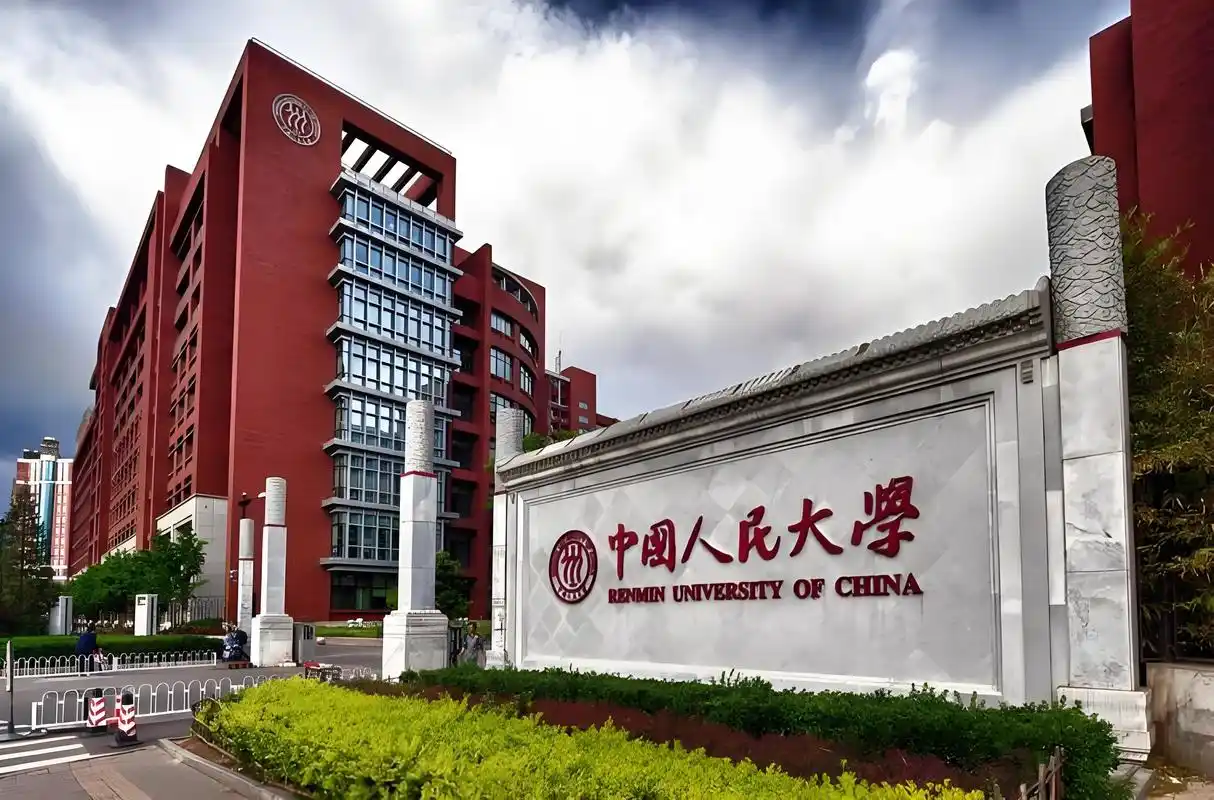
Renmin University of China (RUC), commonly referred to as 'Renda', is located in Haidian District, Beijing. It is a university directly under the Central Government of China and the Ministry of Education, co-built by the Ministry and the Beijing Municipal Government. RUC is a national key university under the 'Double First-Class', 'Project 211', and 'Project 985' initiatives. It is also part of the 'Project 111', the 'Excellent Legal Talent Education and Training Plan', and the 'Excellent Agricultural and Forestry Talent Education and Training Plan'. The university is a member of the World University Network, the Asia-Pacific Association for International Education, and the Beijing-Hong Kong University Alliance. As a comprehensive research university focusing on humanities and social sciences, it is hailed as a banner in China's higher education in these fields. RUC traces its origins to the Shaanbei Public School founded in 1937, as well as the North China United University, Northern University, and North China University. On December 16, 1949, the Government Administration Council of the Central People's Government passed the decision to establish Renmin University of China. On October 3, 1950, RUC was officially inaugurated based on North China University, becoming the first new-type regular university founded in New China. In 1953, the Central Institute of Finance and Economics and the School of Finance and Economics of Shanxi University were merged into RUC. In 1954, it was designated as a comprehensive university focusing on social sciences and one of the first national key universities. In 1960, it was designated as a comprehensive national key university. In 2017, it was selected for the national 'Double First-Class' construction list. On August 31, 2025, the Tongzhou campus of RUC was officially put into use. As of May 2025, RUC has four campuses: Zhongguancun, Tongzhou, Zhangzizhong, and Suzhou. It comprises 6 faculties, offering 89 bachelor's degree programs. It has 37 first-level master's degree authorization points, 27 first-level doctoral degree authorization points, 37 professional master's degree categories, 2 professional doctoral degree categories, and 21 postdoctoral research stations. The university has 1,970 full-time teachers and 27,630 enrolled students. After the July 7 Incident in 1937, to cultivate revolutionary cadres and meet the needs of the Anti-Japanese War, the Central Committee of the Communist Party of China decided to establish the Shaanbei Public School at the end of July 1937. It was prepared by Lin Boqu, Wu Yuzhang, Dong Biwu, Xu Teli, Zhang Yunyi, Cheng Fangwu, and others, with Cheng Fangwu appointed as the president. The school operated under a president responsibility system under the leadership of the Party group, directly under the Central Organization Department and the Central Propaganda Department, and was a revolutionary university directly led by the CPC Central Committee. On October 23, 1937, Comrade Mao Zedong wrote an inscription for the establishment and opening of the school, outlining its tasks and talent cultivation goals. On November 1, 1937, the school held its opening ceremony. The school's educational purpose and training objectives were to 'implement national defense education and cultivate anti-war talents'. It formulated an educational policy to 'help youth acquire practical methods for anti-war work and the minimum theoretical foundation for national self-defense', and developed a teaching plan based on the principle of 70% politics and 30% military affairs, emphasizing the integration of theory and practice, concise content, and consistency between teaching and learning. Over two years, the school trained over 6,000 students and recruited more than 3,000 youth into the CPC. In the summer of 1939, as the situation of the Anti-Japanese War changed, the Japanese invaders and the Kuomintang diehards intensified their attacks on the liberated areas. In June, the CPC Central Committee decided to merge the Shaanbei Public School, Yan'an Lu Xun Academy of Arts, Yan'an Workers' School, and Anwubao Wartime Youth Training Class to form the North China United University, which would operate behind enemy lines in North China. On July 7, 1939, the North China United University was established in Yan'an, operating under a president responsibility system under the leadership of the Party group, with departments of Social Sciences, Literature and Arts, Workers, and Youth. Its educational policy was to cultivate revolutionary cadres for the needs of actual revolutionary struggle, emphasize the integration of theory and practice, and adhere to the principles of conciseness and popularization. Its motto was 'Unity, Progress, Hard Work, Determination'. The university implemented military management, and the cadres it trained were able to adapt to the needs of wartime work. It was the first institution of higher learning run by the CPC behind enemy lines, hailed as 'a sword inserted into the enemy's heart'. In 1940, the North China United University reached its peak with over 4,000 people, including more than 3,000 students. It had the School of Social Sciences (with departments of Political Science and Law, and Finance and Economics), the School of Education (with the Department of Education), the School of Literature and Arts (with departments of Drama, Music, Fine Arts, and Literature), and the School of Engineering (with departments of Mechanics and Mining). In addition to the existing specialized courses, undergraduate and preparatory courses were added. Later, the School of Political Science and Law, the Mass Work Department, and the Middle School Department were established.
Sources & verification
- Verification
- Partly verified
- Verified on
- 2026-05-10
- Last updated
- 2026-09-24
- Source link
- www.campuschina.org ↗
- Source notes
- Official CampusChina guide (program code: 121845)
Confirm requirements, funding and deadlines in the admissions office’s current announcement.