
Government/University Scholarship
Southwestern University of Finance and Economics 2026 Belt and Road Scholarship for International Students
ClosedVerified
Southwestern University of Finance and Economics 2026 Belt and Road Scholarship for International Students. Eligible study levels: Bachelor’s, Master’s. Funding: Scholarships are divided into full and partial scholarships: (1) Full scholarship 1. Tuition 2. On-campus accommodation 3. Living expenses (2) Partial scholarship Tuition waiver only
TuitionAccommodation
- Scholarship type
- Government/University Scholarship
- Degree level
- Bachelor / Master
- Location
- Sichuan · Chengdu
- Application deadline
- 2026-04-03
Overview
Southwestern University of Finance and Economics 2026 Belt and Road Scholarship for International Students. Eligible study levels: Bachelor’s
Master’s. Funding: Scholarships are divided into full and partial scholarships:
(1) Full scholarship
1. Tuition
2. On-campus accommodation
3. Living expenses
Funding coverage
Funding tiers
Eligibility may differ by tier. Check the applicable degree and requirements.
Full scholarship
- Eligible degree
- Bachelor’s, Master’s
- Funding
- Full scholarship and [source fragment]
- Tier requirements
- (1) Non-Chinese citizens with valid foreign passport, good physical/mental health and excellent grades, meeting the Nationality Law, Ministry of Education Jiaowaihan [2020] No. 12 and other laws/regulations; (2) Compliance with Chinese laws/regulations and university rules; (3) Meet either academic condition: 1. Current-year high school graduates (bachelor’s) or undergraduate graduates (master’s) must obtain the corresponding nationally recognized degree certificate before enrollment in the admission year, otherwise admission invalid [the source uses degree certificate for both]; 2. Nationally recognized high school graduation (bachelor’s) or undergraduate graduation (master’s). (4) Age 1. Bachelor’s: 18-30; 2. Master’s: 18-35; Age assessed with reference to before September 1,2026. (5) Language requirements 1. Chinese-taught majors (1) Applicants with more than two years of Chinese-taught subject study may omit Chinese test evidence; (2) Chinese-taught applicants must provide HSK, with a minimum of passing HSK Level 5 and at least 60 in each subject. 2. English-taught majors (1) Native English speakers or applicants with more than two years of English-taught subject study may omit English test evidence; (2) Non-native English-speaking undergraduates require IELTS 6.0, TOEFL 80 or Duoling 105 or above; non-native English-speaking graduate applicants require IELTS 6.5, TOEFL 95 or Duoling 120 or above. [Duoling is the source’s test name.] 3. Above language requirements are minimums. (6) No concurrent Chinese Government Scholarship; (7) Applicants complete the scholarship application independently themselves.
Partial scholarship
- Eligible degree
- Bachelor’s, Master’s
- Funding
- Partial scholarships; two categories: (1) [source fragment]
- Tier requirements
- (1) Non-Chinese citizens with valid foreign passport, good physical/mental health and excellent grades, meeting the Nationality Law, Ministry of Education Jiaowaihan [2020] No. 12 and other laws/regulations; (2) Compliance with Chinese laws/regulations and university rules; (3) Meet either academic condition: 1. Current-year high school graduates (bachelor’s) or undergraduate graduates (master’s) must obtain the corresponding nationally recognized degree certificate before enrollment in the admission year, otherwise admission invalid [the source uses degree certificate for both]; 2. Nationally recognized high school graduation (bachelor’s) or undergraduate graduation (master’s). (4) Age 1. Bachelor’s: 18-30; 2. Master’s: 18-35; Age assessed with reference to before September 1,2026. (5) Language requirements 1. Chinese-taught majors (1) Applicants with more than two years of Chinese-taught subject study may omit Chinese test evidence; (2) Chinese-taught applicants must provide HSK, with a minimum of passing HSK Level 5 and at least 60 in each subject. 2. English-taught majors (1) Native English speakers or applicants with more than two years of English-taught subject study may omit English test evidence; (2) Non-native English-speaking undergraduates require IELTS 6.0, TOEFL 80 or Duoling 105 or above; non-native English-speaking graduate applicants require IELTS 6.5, TOEFL 95 or Duoling 120 or above. [Duoling is the source’s test name.] 3. Above language requirements are minimums. (6) No concurrent Chinese Government Scholarship; (7) Applicants complete the scholarship application independently themselves.
Full scholarship
- Eligible degree
- Bachelor’s, Master’s
- Funding
- Full scholarship 1. Tuition 2. On-campus accommodation 3. Living expenses (2)
- Tier requirements
- (1) Non-Chinese citizens with valid foreign passport, good physical/mental health and excellent grades, meeting the Nationality Law, Ministry of Education Jiaowaihan [2020] No. 12 and other laws/regulations; (2) Compliance with Chinese laws/regulations and university rules; (3) Meet either academic condition: 1. Current-year high school graduates (bachelor’s) or undergraduate graduates (master’s) must obtain the corresponding nationally recognized degree certificate before enrollment in the admission year, otherwise admission invalid [the source uses degree certificate for both]; 2. Nationally recognized high school graduation (bachelor’s) or undergraduate graduation (master’s). (4) Age 1. Bachelor’s: 18-30; 2. Master’s: 18-35; Age assessed with reference to before September 1,2026. (5) Language requirements 1. Chinese-taught majors (1) Applicants with more than two years of Chinese-taught subject study may omit Chinese test evidence; (2) Chinese-taught applicants must provide HSK, with a minimum of passing HSK Level 5 and at least 60 in each subject. 2. English-taught majors (1) Native English speakers or applicants with more than two years of English-taught subject study may omit English test evidence; (2) Non-native English-speaking undergraduates require IELTS 6.0, TOEFL 80 or Duoling 105 or above; non-native English-speaking graduate applicants require IELTS 6.5, TOEFL 95 or Duoling 120 or above. [Duoling is the source’s test name.] 3. Above language requirements are minimums. (6) No concurrent Chinese Government Scholarship; (7) Applicants complete the scholarship application independently themselves.
Partial scholarship
- Eligible degree
- Bachelor’s, Master’s
- Funding
- Partial scholarship Tuition waiver only
- Tier requirements
- (1) Non-Chinese citizens with valid foreign passport, good physical/mental health and excellent grades, meeting the Nationality Law, Ministry of Education Jiaowaihan [2020] No. 12 and other laws/regulations; (2) Compliance with Chinese laws/regulations and university rules; (3) Meet either academic condition: 1. Current-year high school graduates (bachelor’s) or undergraduate graduates (master’s) must obtain the corresponding nationally recognized degree certificate before enrollment in the admission year, otherwise admission invalid [the source uses degree certificate for both]; 2. Nationally recognized high school graduation (bachelor’s) or undergraduate graduation (master’s). (4) Age 1. Bachelor’s: 18-30; 2. Master’s: 18-35; Age assessed with reference to before September 1,2026. (5) Language requirements 1. Chinese-taught majors (1) Applicants with more than two years of Chinese-taught subject study may omit Chinese test evidence; (2) Chinese-taught applicants must provide HSK, with a minimum of passing HSK Level 5 and at least 60 in each subject. 2. English-taught majors (1) Native English speakers or applicants with more than two years of English-taught subject study may omit English test evidence; (2) Non-native English-speaking undergraduates require IELTS 6.0, TOEFL 80 or Duoling 105 or above; non-native English-speaking graduate applicants require IELTS 6.5, TOEFL 95 or Duoling 120 or above. [Duoling is the source’s test name.] 3. Above language requirements are minimums. (6) No concurrent Chinese Government Scholarship; (7) Applicants complete the scholarship application independently themselves.
Requirements & documents
Application dates & process
Application Opens: 1/1 Application Deadline: 4/3 Review Cycle: Document review and interviews / expert review take approximately 4–6 weeks
Universities & programs
Universities
About the university
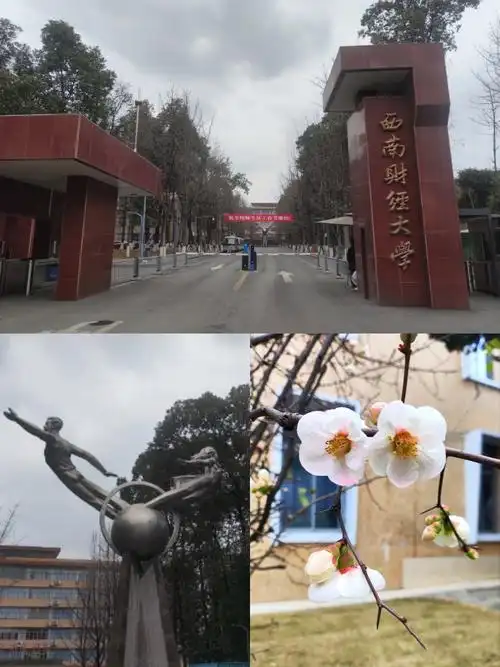
Southwestern University of Finance and Economics (SWUFE), located in Chengdu, Sichuan Province, is a national key university directly under the Ministry of Education of the People's Republic of China. It is jointly built by the Ministry of Education and Sichuan Province, and is a key construction university under the national "Double First-Class" initiative, "Project 211", and "Project 985 Advantage Discipline Innovation Platform". It is also one of the first batch of pilot institutions in Sichuan for the "Quality Certification of International Students in China". The history of SWUFE can be traced back to Guanghua University, founded in Shanghai in 1925. In 1938, due to the War of Resistance against Japan, Guanghua University moved inland and established the Chengdu Branch. During the nationwide college reorganization from 1952 to 1953, the finance and economics departments of 17 institutions in Southwest China were merged to form Sichuan Institute of Finance and Economics. After undergoing separation, merger, and renaming in the 1960s, it was restored as Sichuan Institute of Finance and Economics in 1978. In 1979, it was placed under the administration of the People's Bank of China. It was renamed Southwestern University of Finance and Economics in 1985. In 1997, it became a key university under "Project 211". In 2000, it was transferred to the direct administration of the Ministry of Education as an independent institution. In 2011, it became a university under the "Project 985 Advantage Discipline Innovation Platform". In 2017, it became a "Double First-Class" construction university. As of March 2025, SWUFE has two campuses, Guanghua and Liulin, covering an area of over 2,300 mu. It has 26 teaching units, offers 46 undergraduate programs, and has 6 post-doctoral research stations, 10 first-level doctoral degree authorization disciplines, 3 professional doctoral degree categories, 4 first-level master's degree authorization disciplines, and 19 professional master's degree categories. It has over 15,300 full-time undergraduate students, over 8,500 master's students, and over 1,400 doctoral students. On June 3, 1925, amid the anti-imperialist patriotic movement of the "May 30th Incident" in Shanghai, hundreds of faculty and students left Saint John's University to establish Guanghua University. On September 12, the school held its opening ceremony at the Xiafei Road campus. On August 13, 1937, the Battle of Shanghai broke out, and the Great West Road campus of Guanghua University was burned down by Japanese forces. Then-President Zhang Shouyong decided to establish a branch in Sichuan, and Xie Lin, then Dean of the Business School of Guanghua University, was entrusted to prepare for the branch in Sichuan. Guanghua University gate; group photo of all faculty and staff at the first opening of Guanghua University; 1934 photo of the Third Accounting Association of Guanghua University; Guanghua University emblem; groundbreaking ceremony of the Chengdu Branch of Guanghua University. In 1945, after the victory of the War of Resistance, Guanghua University decided to re-establish its campus in Shanghai. In view of the Ministry of Education's resolution that "universities shall not permanently establish branches in other places", the board of directors of Guanghua University wrote to the Ministry of Education, proposing to follow the plan agreed upon by President Zhang Shouyong and Vice President Xie Lin to transfer the Chengdu Branch to local Sichuanese. The school was renamed Chenghua University, meaning Chengdu Guanghua University, becoming a sister school to Guanghua University in Shanghai. In November, the Ministry of Education approved the transfer of the Guanghua Chengdu campus to Sichuanese. Documents reporting the transfer; group photo of Chenghua University graduates in 1952. In October 1952, the school came under the leadership of the Southwest Military and Political Committee (restructured as the Southwest Administrative Committee in March 1953). Following the instructions of the committee, Chenghua University became a public institution. It was then merged with the transferred Chengdu Accounting College, the Economics Department of West China University, the Business Administration Department of North Sichuan University, and the Banking and Insurance Department of Chongqing Business College to form Sichuan Institute of Finance and Economics.
Sources & verification
- Verification
- Verified
- Verified on
- 2026-09-20
- Last updated
- 2026-11-06
- Source link
- international.swufe.edu.cn ↗
- Source notes
- Southwestern University of Finance and Economics — 2026 application guide and funding details for Southwestern University of Finance and Economics 2026 Belt and Road Scholarship for International Students (verified by the user)
Confirm requirements, funding and deadlines in the admissions office’s current announcement.