
Government/University Scholarship
Ministry of Education–Guangxi Zhuang Autonomous Region Joint Scholarship Program for ASEAN Students
Application status unknownVerified
Ministry of Education–Guangxi Zhuang Autonomous Region Joint Scholarship Program for ASEAN Students. Eligible study levels: Bachelor’s, Master’s, Doctoral. Funding: Tuition and accommodation fee waivers, a living allowance and comprehensive medical insurance for study in China; international travel expenses are paid by the student.
TuitionAccommodationMedical insurance
- Scholarship type
- Government/University Scholarship
- Degree level
- Bachelor / Master / PhD
- Location
- Guangxi · Guilin
- Application deadline
- Date to be confirmed
Overview
Ministry of Education–Guangxi Zhuang Autonomous Region Joint Scholarship Program for ASEAN Students. Eligible study levels: Bachelor’s
Master’s
Doctoral. Funding: Tuition and accommodation fee waivers
a living allowance and comprehensive medical insurance for study in China
international travel expenses are paid by the student.
Funding coverage
Funding tiers
Eligibility may differ by tier. Check the applicable degree and requirements.
Standard funding
- Eligible degree
- Bachelor’s, Master’s, Doctoral
- Funding
- Tuition and accommodation fee waivers, a living allowance and comprehensive medical insurance for study in China; international travel expenses are paid by the student.
- Tier requirements
- (1) Eligible countries Nationals of the 11 ASEAN countries: Brunei, Cambodia, Indonesia, Laos, Malaysia, Myanmar, the Philippines, Singapore, Thailand, Vietnam and Timor-Leste. (2) Educational and age requirements 1. Undergraduate: academic ability equivalent to high school graduation, excellent grades, generally no older than 25; 2. Master’s: bachelor’s degree, excellent grades, generally no older than 35; 3. Doctoral: master’s degree, excellent grades, generally no older than 40.
Requirements & documents
Application dates & process
Review Cycle: Document review and interviews / expert review take approximately 4–6 weeks
Universities & programs
Universities
About the university
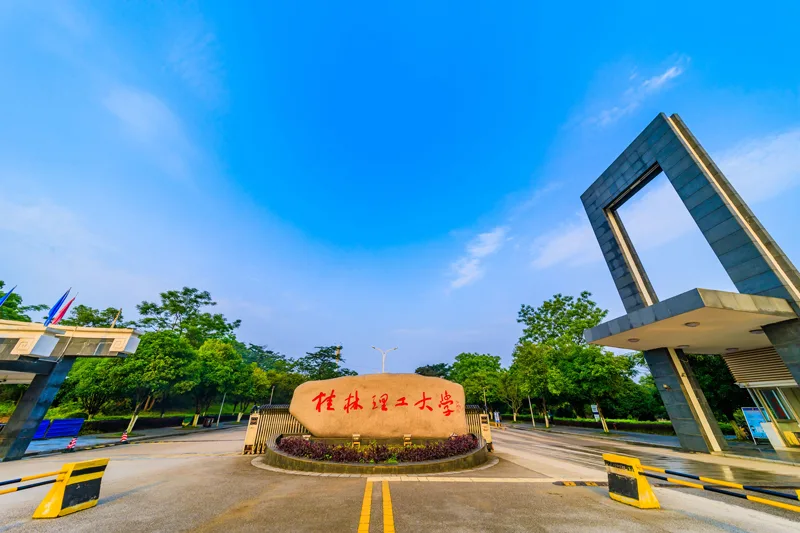
Guilin University of Technology (GUT), abbreviated as Guigong, is located in Guilin City, Guangxi Zhuang Autonomous Region. It is a higher education institution jointly established by the central and local governments, selected for the National 'Midwest University Basic Capacity Building Project,' the National Key Research and Development Program, the Excellent Engineer Education and Training Program, the National Demonstration University for Deepening Innovation and Entrepreneurship Education Reform, and the National Innovation and Entrepreneurship Education Practice Base. It is also a national defense education characteristic school, a Guangxi first-class discipline construction university, and the only university in China conducting research on Antarctic meteorite classification. The university is a multidisciplinary institution with engineering as its core, and coordinated development across eight major disciplines: engineering, science, management, humanities, economics, law, arts, and agriculture. The university originated from the Guilin Geological School founded in 1956, and was successively under the jurisdiction of the Ministry of Heavy Industry, the Ministry of Metallurgical Industry, and the China National Nonferrous Metals Industry Corporation. In 1998, its management system was changed to joint construction by the central and local governments, with daily management primarily by Guangxi. The university's history can be traced back to the Guangxi Provincial Special Education Teacher Training Institute (formerly Guilin Ethnic Normal School) established in 1935. It began undergraduate education in 1960, was renamed Guilin College of Metallurgical Geology in 1978, started graduate education in 1986, was renamed Guilin Institute of Technology in 1993, merged with Nanning Nonferrous Metals Industry School in 2000, merged with the former Guilin Ethnic Normal School in 2004, and was officially renamed Guilin University of Technology in 2009. As of March 2026, the university has four campuses: Guilin Pingfeng, Guilin Yanshan, Nanning Anji, and Nanning Konggang, covering a total area of over 3,300 mu. It has 19 secondary teaching units, 69 undergraduate programs, 37 higher vocational programs, 3 postdoctoral research stations, over 3,300 faculty and staff, and more than 47,000 full-time students. It has 6 doctoral degree authorization points, 37 master's degree authorization points, 22 first-level discipline master's degree authorization points, and 15 professional master's degree authorization points. In January 1956, in response to the demand for heavy industry talent under the First Five-Year Plan, the Ministry of Heavy Industry decided to establish a geological secondary specialized school in Guilin. To support large-scale industrialization, the Guilin Geological School (predecessor of Guilin University of Technology) was planned. Over 30 faculty and staff were transferred from Changchun Geological School (now Changchun University of Science and Technology), Changchun Surveying School (now Changchun Institute of Technology), and other metallurgical system institutions to Guilin for preparatory work. Finally, the school was built at the Liulupai market at the foot of Pingfeng Mountain. On August 31, the Guilin Geological School was officially established and began enrolling its first batch of 500 students as a four-year secondary specialized school, also known as the Ministry of Heavy Industry Guilin Geological School. In October of the same year, the school issued its first semester work plan, covering seven key areas including teaching, infrastructure, and personnel, emphasizing collaboration and standardized management. The teaching building was put into use in 1956. In August 1958, the school was renamed 'Guangxi Metallurgical Junior College.' With the development of the national economy, culture, and education, the central government delegated the school to Guangxi, implementing dual leadership with Guangxi as the main body. It offered majors such as metallurgy, mechanical and electrical engineering, mining, mineral processing, and metalworking, and established the Pinggui Xiwan branch. In the second half of 1961, the Guangxi government decided to dissolve the Nanning Geological Junior College, Tianyang Coal and Petroleum School, and Pinggui Xiwan Branch, merging some faculty, students, and equipment into Guangxi Mining Junior College. From July 1963 to October 1970, the school was renamed 'Guilin Metallurgical Geology School' and returned to direct jurisdiction under the Ministry of Metallurgical Industry. In March 1971, the school was renamed 'Guilin Metallurgical Geology Research Institute.' With State Council approval, the Ministry of Metallurgy relocated the Beijing Geological Research Institute to Guilin to merge with the Guilin Metallurgical Geology Research Institute, attempting to implement a new system integrating teaching, research, and production. Later, the institute and school were separated, with the geological research institute moving out and establishing a new site.
Sources & verification
- Verification
- Verified
- Verified on
- 2026-09-20
- Last updated
- 2026-11-06
- Source link
- cfs.glut.edu.cn ↗
- Source notes
- Guilin University of Technology 2026 Application Guide and Funding Rules for the Ministry of Education–Guangxi Zhuang Autonomous Region Joint Scholarship for ASEAN International Students (verified by the user)
Confirm requirements, funding and deadlines in the admissions office’s current announcement.