
Government/University Scholarship
Chinese Government Scholarship High-Level Postgraduate Program
ClosedVerified
Chinese Government Scholarship High Level Postgraduate Program. Levels: undergraduate, master’s and doctoral [as listed in the source]. Coverage: 1. Tuition waived; 2. Free dormitory accommodation or accommodation subsidy; 3. Living allowance: undergraduates RMB 2,500/month; master’s students RMB 3,000/month; doctoral students RMB 3,500/month; 4. Comprehensive medical insurance: RMB 800/person/year.
TuitionAccommodationMedical insurance
- Scholarship type
- Government/University Scholarship
- Degree level
- Bachelor / Master / PhD
- Location
- Guangdong · Guangzhou
- Application deadline
- 2026-03-01
Overview
Chinese Government Scholarship High Level Postgraduate Program. Levels: undergraduate
master’s and doctoral as listed in the source. Coverage: 1. Tuition waived
2. Free dormitory accommodation or accommodation subsidy
3. Living allowance: undergraduates RMB 2
500/month
master’s students RMB 3
Funding coverage
Funding tiers
Eligibility may differ by tier. Check the applicable degree and requirements.
Standard funding
- Eligible degree
- Bachelor’s, Master’s, Doctoral
- Funding
- 1. Tuition waived; 2. Free dormitory accommodation or accommodation subsidy; 3. Living allowance: undergraduates RMB 2,500/month; master’s students RMB 3,000/month; doctoral students RMB 3,500/month; 4. Comprehensive medical insurance: RMB 800/person/year.
- Tier requirements
- 1. Non-Chinese citizenship, valid foreign passport. 2. Good physical/mental health, meeting visa/residence medical standards. 3. Interest in Chinese medicine, strong biomedical/Chinese medicine foundations. Graduate categories: Chinese clinical medicine, basic Chinese medicine, Chinese medical humanities, and Chinese materia medica. Backgrounds:(1)Chinese/Western clinical majors: undergraduate and master’s studies in the same or related Chinese Medicine, Acupuncture and Tuina, Clinical Integrated Chinese and Western Medicine, Clinical Medicine; non-clinical Pharmacy, Chinese Materia Medica, Nursing, Medical Technology excluded. (2) Basic Chinese Medicine/Basic Medicine: both undergraduate and master’s studies in corresponding medicine, pharmacy or biology disciplines. (3) Chinese medical humanities: both undergraduate and master’s studies in relevant medicine, pharmacy, biology, philosophy, law, literature, history, psychology, management or informatics disciplines. (4) Chinese Materia Medica/Pharmacy: both undergraduate and master’s studies in corresponding Chinese materia medica, pharmacy or biology disciplines. (5)Nursing: undergraduate Nursing or related medical major. 4. Friendly toward China, good character, law-abiding, no university violations, public security penalties or criminal record. 5. HSK5≥180; native Chinese/prior Chinese-medium applicants may be exempt upon evidence/university approval. 6. Master’s: degree/equivalent qualification comparable to mainland Chinese bachelor’s, in principle35 or younger; doctoral: comparable to mainland Chinese master’s, in principle40 or younger.
Requirements & documents
Application dates & process
Application Deadline: 3/1 Review Cycle: Document review and interviews / expert review take approximately 4–6 weeks
Universities & programs
Universities
About the university
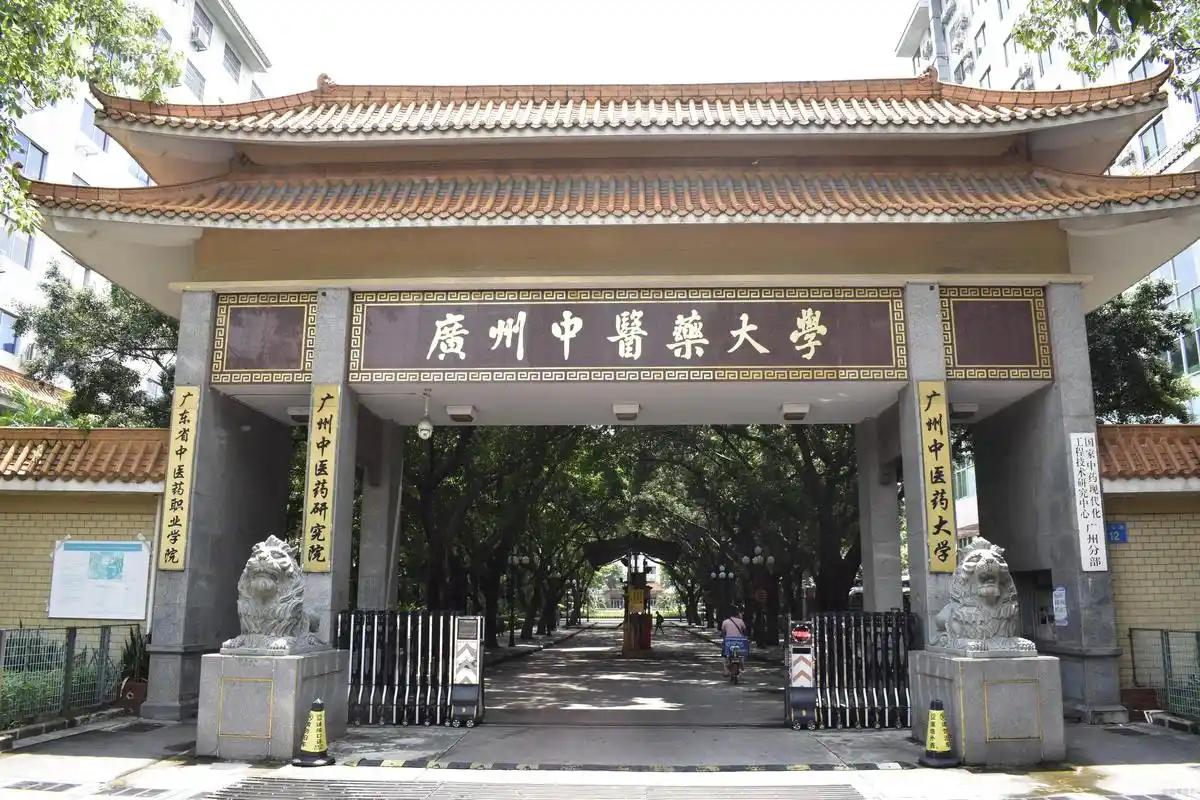
Guangzhou University of Chinese Medicine (GZUCM), located in Guangzhou, Guangdong Province, is a full-time public undergraduate institution under the administration of Guangdong Province. It is jointly established by the Ministry of Education, the National Administration of Traditional Chinese Medicine, and the People's Government of Guangdong Province. As one of the first four traditional Chinese medicine (TCM) higher education institutions established in China, it serves as a clinical pharmacology research base of the Ministry of Health and one of the training bases for Chinese medicine practitioners. The university is also a national "Double First-Class" discipline construction university. GZUCM traces its origins to the Guangdong Specialized School of Chinese Medicine founded in 1924, renamed Guangdong Junior College of Chinese Medicine in 1936, restructured as Guangdong Chinese Medicine Advanced School in 1952, and established as Guangzhou College of Traditional Chinese Medicine in 1956—one of the first four TCM higher education institutions in the People's Republic of China. It was renamed Guangdong College of Traditional Chinese Medicine in 1970, restored to Guangzhou College of Traditional Chinese Medicine in 1978, and adopted its current name, Guangzhou University of Chinese Medicine, in 1995, with an uninterrupted history of education. In June 2003, the university passed the overall acceptance inspection of the "Ninth Five-Year Plan" and "211 Project" key discipline construction organized by the National Administration of Traditional Chinese Medicine and the Guangdong Provincial Government with excellent results. As of March 2025, the university has two campuses—University Town and Sanyuanli—covering a total area of 1,205 mu. It comprises 15 secondary colleges, 4 directly affiliated hospitals, and offers 23 undergraduate programs. The university has 7 first-level master's degree authorization points, 6 master's professional degree categories, 3 first-level doctoral degree authorization points, 1 doctoral professional degree category, and 3 postdoctoral research stations. It has 13,599 faculty and staff members and 21,178 enrolled students. In November 1912, the Beiyang government's Ministry of Education did not include Chinese medicine in the "Medical Education Regulations," sparking protests from the Chinese medicine community nationwide, including Guangdong. In March 1913, pharmacy associations in Guangzhou and Hong Kong took action, gathering at the Guangzhou Shoushi Guild Hall to decide on establishing a Chinese medicine school and issued the "Declaration on the Preparation of Guangdong Specialized School of Chinese Medicine." This school is the predecessor of Guangzhou University of Chinese Medicine. Starting in 1913, donations from Guangzhou and Hong Kong pharmaceutical industries purchased four houses on Mahang Street and a plot of land on Nanhao Street in Guangzhou as the school site. In December 1917, Lu Naitong and others submitted an application for registration to the Guangdong Governor's Office, along with the school's charter. On January 15, 1918, the application was approved by the Guangdong Governor's Office. On January 27, it was also approved by the Ministry of Internal Affairs of the Beiyang government. In 1924, Lu Naitong and others applied to the Southern government for registration and received approval. In 1924, the Guangdong Specialized School of Chinese Medicine was established and began enrolling students in July, admitting 60 students in its first cohort. On September 15, the school held its official opening ceremony. At that time, the campus covered ten mu and had three main buildings. In 1927, the Nanjing National Government required that Chinese medicine schools not use the term "school," so the Guangdong Specialized School of Chinese Medicine temporarily changed its name to "Guangdong Chinese Medicine Society." In 1936, with the support of Guangdong warlord Chen Jitang, the school officially restored the name "school" as "Guangdong Junior College of Chinese Medicine." During the War of Resistance Against Japan, the school relocated to Hong Kong for instruction. At the end of 1941, Hong Kong fell to the Japanese, and the school suspended operations. After the victory of the Anti-Japanese War, the school resumed enrollment. The Guangdong Specialized School of Chinese Medicine had planned an affiliated hospital as early as 1917. In 1926, a free clinic was opened on campus. In 1928, the school received approval from the Guangdong Provincial Department of Civil Affairs and the Department of Education to establish a hospital. On August 14, 1933, the Affiliated Guangdong Hospital of Chinese Medicine officially opened.
Sources & verification
- Verification
- Verified
- Verified on
- 2026-09-20
- Last updated
- 2026-11-06
- Source link
- studyoverseas.gzucm.edu.cn ↗
- Source notes
- Guangzhou University of Chinese Medicine 2026 Chinese Government Scholarship High Level Postgraduate Program Application Guide and Funding Rules (user-verified)
Confirm requirements, funding and deadlines in the admissions office’s current announcement.