
Government/University Scholarship
Chinese Government Scholarship — Silk Road Program
ClosedVerified
Chinese Government Scholarship Silk Road Program. Eligible study levels: Master’s and Doctoral. Funding: tuition, living expenses and comprehensive medical insurance fees during study in China, with on-campus accommodation provided.
TuitionAccommodationMedical insurance
- Scholarship type
- Government/University Scholarship
- Degree level
- Master / PhD
- Location
- Sichuan · Chengdu
- Application deadline
- 2026-05-02
Overview
Chinese Government Scholarship Silk Road Program. Eligible study levels: Master’s and Doctoral. Funding: tuition
living expenses and comprehensive medical insurance fees during study in China
with on-campus accommodation provided.
Funding coverage
Funding tiers
Eligibility may differ by tier. Check the applicable degree and requirements.
Standard funding
- Eligible degree
- Master’s, Doctoral
- Funding
- Tuition, living expenses and comprehensive medical insurance fees during the applicant’s study in China, with on-campus accommodation provided.
- Tier requirements
- 1. Non-Chinese citizens in good physical and mental health; 2. Doctoral: master’s degree or equivalent qualification, excellent grades, no older than 40; 3. Master’s applicants: bachelor’s degree or equivalent qualification, good grades, no older than 35; 4. Chinese-taught master’s/doctoral applicants require HSK4; 5. Meet Southwest Jiaotong University’s academic and other admission requirements.
Requirements & documents
Application dates & process
Application Deadline: 5/2 Review Cycle: Document review and interviews / expert review take approximately 4–6 weeks
Universities & programs
Universities
About the university
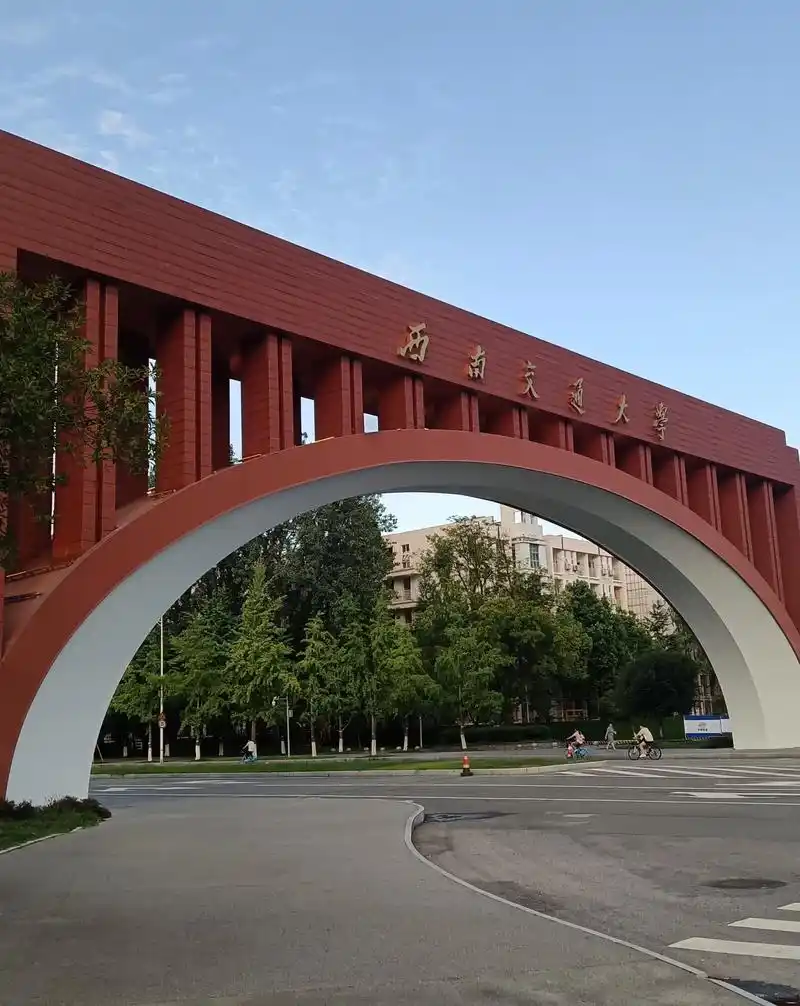
Southwest Jiaotong University (SWJTU), commonly referred to as 'Xinan Jiaoda', is located in Chengdu, Sichuan. It is a national key university directly under the Ministry of Education, and one of the first batch of universities selected for the national 'Double First-Class' initiative, '211 Project', '985 Project Advantage Discipline Innovation Platform', and '2011 Plan'. It has a graduate school. The university is also part of the '111 Plan', the Excellent Engineer Education and Training Program, the National College Student Innovation Experimental Program, the National High-Level University Public-Sponsored Graduate Program, the Chinese Government Scholarship Institution for International Students, one of the first batch of university science and technology achievement transformation and technology transfer bases, one of the first batch of modern industrial colleges, one of the first batch of national innovation and entrepreneurship colleges, a construction unit of the National Excellent Engineer College, and a training institution for the aid-Tibet program. Founded in 1896 in Shanhaiguan, the university was originally named 'Beiyang Railway Official School'. It later went through several name changes: Tangshan Railway and Mining School, Tangshan Industrial Specialized School, Jiaotong University Tangshan School, Ministry of Communications Tangshan University, Tangshan Jiaotong University, National Tangshan Institute of Technology, China Jiaotong University Tangshan Institute of Technology, and Northern Jiaotong University Tangshan Institute of Technology. In 1952, due to the nationwide adjustment of higher education institutions, the school was renamed Tangshan Railway Institute. In 1964, it moved to Emei, Sichuan, and in 1972, it was renamed Southwest Jiaotong University. In 1989, the main campus moved to the Jiuli campus in Chengdu, and in 2002, a new campus was built in Xipu, Chengdu. In 2020, the university cooperated with Chengdu to build the Chengdu Eastern (International) Campus. As of October 2024, the university has four campuses: Jiuli, Xipu, Eastern (International), and Emei, covering a total area of over 5,000 mu. It currently has 33 colleges (centers) and other secondary units, 2 national first-level key disciplines, 10 national second-level key disciplines, 20 first-level doctoral degree authorization points, 5 professional doctoral degree authorization categories, 43 first-level master's degree authorization points, and 17 postdoctoral research stations. The university has over 2,700 full-time teachers and 49,133 enrolled students. Southwest Jiaotong University was founded in 1896, with its predecessor being the Shanhaiguan Beiyang Railway Official School established by the Beiyang Railway Bureau. In 1900, due to the invasion of the Eight-Nation Alliance, the school was forced to close. In 1905, the school reopened in Tangshan and was renamed Tangshan Railway School. In 1906, a mining department was added, and it was renamed Shanhaiguan Inside and Outside Railway and Mining School. In 1908, the school was directly under the Ministry of Posts and Communications of the Qing government and renamed the Ministry of Posts and Communications Tangshan Railway and Mining School. In 1912, the Republic of China was established. The Ministry of Posts and Communications of the Qing government was replaced by the Ministry of Communications of the Republic government, and the school came under the direct jurisdiction of the Ministry of Communications, renamed the Ministry of Communications Tangshan Railway School. In 1913, by order of the Ministry of Education and the Ministry of Communications, the school was renamed Tangshan Industrial Specialized School. In 1921, the Ministry of Communications of the Beiyang government established Jiaotong University, with its headquarters in Beijing and three schools in Beijing, Tangshan, and Shanghai. The school was renamed Jiaotong University Tangshan School. In 1922, the Ministry of Communications reorganized Jiaotong University, establishing Tangshan University and Nanyang University, and the school was renamed the Ministry of Communications Tangshan University. In February 1928, the Ministry of Communications of the Beiyang government ordered Tangshan University to be renamed Tangshan Jiaotong University. In June of the same year, the National Government announced the unification of the north and south, and Tangshan Jiaotong University was renamed the Second Jiaotong University. Later that year, the Ministry of Communications reorganized Jiaotong University, with its headquarters in Shanghai. The school was renamed Jiaotong University Tangshan Civil Engineering College. In October of the same year, the National Government established the Ministry of Railways, and the school was temporarily placed under its direct jurisdiction. In November, after Jiaotong University was transferred to the Ministry of Railways, it was renamed the Ministry of Railways Jiaotong University, with the Shanghai headquarters, the Beijing Railway Management College, and the Tangshan Engineering College. The school was renamed Jiaotong University Tangshan Engineering College. After the 'July 7 Incident' in 1937, the school was occupied by the Japanese army. With the efforts of the faculty, students, and alumni, the school reopened in Xiangtan, Hunan at the end of the year. In March 1938, the Ministry of Education ordered that the Beijing Railway Management College of Jiaotong University be temporarily merged into the Tangshan Engineering College. In May, the school moved to Yangjiatan, Xiangxiang, Hunan. In 1938, after Wuhan fell, the entire school was forced to move westward again. In 1939, the school resumed classes in Pingyue Ancient City, Guizhou (now Fuquan City). In July 1941, the Ministry of Education ordered the school to be renamed National Jiaotong University Tangshan Engineering College and Beijing Railway Management College. Due to controversy over this name within the school, in January 1942, the Ministry of Education changed its previous order and established the National Jiaotong University Guizhou Branch, consisting of the Tangshan Engineering College and the Beijing Railway Management College. In November 1944, the Japanese army captured Dushan, Guizhou, and the school was forced to move again to Bishan, Sichuan. After the victory of the Anti-Japanese War, in August 1946, by order of the Ministry of Education, the school was renamed National Tangshan Institute of Technology, directly under the Ministry of Education, and moved back to its original site in Tangshan. After the founding of the People's Republic of China in 1949, the school was taken over by the Ministry of Railways of the Central Military Commission and established as China Jiaotong University, with its headquarters in Beijing and two branches: Tangshan Institute of Technology and Beijing Railway Management College. The school was renamed China Jiaotong University Tangshan Institute of Technology. In August 1950, the school was renamed Northern Jiaotong University Tangshan Institute of Technology. In 1952, during the nationwide adjustment of higher education institutions, the departments (groups) of mining, metallurgy, chemical engineering, architecture, water conservancy, and communications were transferred to other schools, and the school was renamed Tangshan Railway Institute. In September 1964, in accordance with the spirit of the Central Committee of the Communist Party of China to build the 'Third Front', the Ministry of Railways decided to move the school to Emei, Sichuan. In 1972, the school was renamed Southwest Jiaotong University. In 1989, the main campus moved to Chengdu (Emei became a branch campus, later changed to a campus). In 2002, a new campus was built in Xipu, Chengdu, forming the current pattern of 'one university, two locations, three campuses'. On February 26, 2016, Southwest Jiaotong University signed the 'Strategic Cooperation Framework Agreement on Deepening Comprehensive Innovation Reform and Jointly Building a World-Class University' with the Chengdu Municipal People's Government. In October, the Sichuan Provincial People's Government and Southwest Jiaotong University signed a strategic cooperation agreement.
Sources & verification
- Verification
- Verified
- Verified on
- 2026-09-20
- Last updated
- 2026-11-06
- Source link
- sie.swjtu.edu.cn ↗
- Source notes
- Southwest Jiaotong University — 2026 application guide and funding details for Chinese Government Scholarship — Silk Road Program (verified by the user)
Confirm requirements, funding and deadlines in the admissions office’s current announcement.