
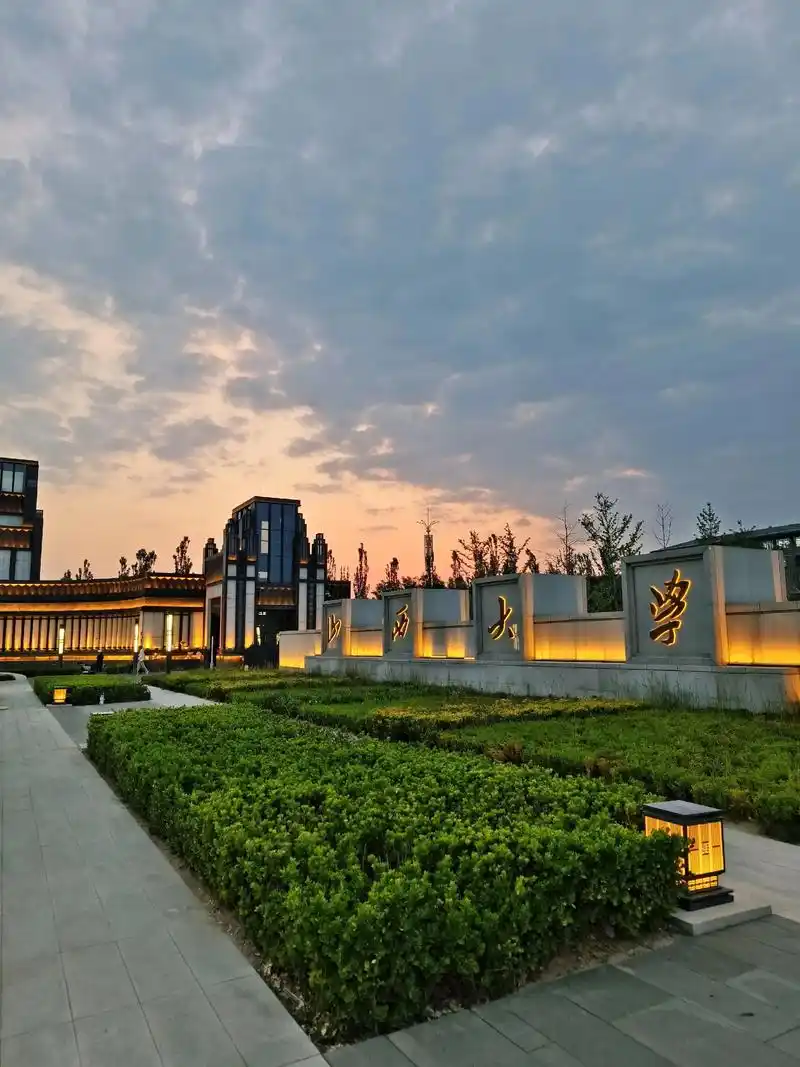
Government/University Scholarship
Government Scholarship for Studying Abroad in Shanxi
Application status unknownNot verified
Government Scholarship for Studying Abroad in Shanxi is an attractive sponsorship program for international students with financial support of up to 25,000 RMB/year. With the aim of attracting talents and promoting cultural exchange, the program expands high-quality study opportunities in Shanxi, China for candidates at the undergraduate, master's, doctoral and postgraduate levels.
TuitionAccommodation
- Scholarship type
- Government/University Scholarship
- Degree level
- Bachelor / Master / PhD
- Location
- Shanxi · Taiyuan
- Application deadline
- Date to be confirmed
Overview
Government Scholarship for Studying Abroad in Shanxi is an attractive sponsorship program for international students with financial support of up to 25
000 RMB/year. With the aim of attracting talents and promoting cultural exchange
the program expands high-quality study opportunities in Shanxi
China for candidates at the undergraduate
master's
doctoral and postgraduate levels.
Funding coverage
Funding tiers
Eligibility may differ by tier. Check the applicable degree and requirements.
Bachelor’s funding tier
- Eligible degree
- Bachelor’s
- Funding
- Undergraduates Master’s students Doctoral students
- Tier requirements
- Meets the visa, health and academic requirements for study in China
Visiting students funding tier
- Eligible degree
- Visiting students
- Funding
- Visiting students For program details, visit Shanxi University’s School of International Education and Exchange: http://siee.sxu.edu.cn/ Scholarship Coverage Doctoral Programs Tuition waived Free accommodation Monthly living allowance: RMB 2,500 Master’s Programs Tuition waived Free accommodation Monthly living allowance: RMB 2,000 Undergraduate Programs Funding: RMB 15,000 per year Some universities use this funding to pay a RMB 1,500 monthly living allowance; others deduct it directly from tuition. Application and Enrollment Dates Application period: April 10–June 10 each year Enrollment: September Note: Dates may change annually. Consult the latest notice or contact the university to confirm. Application requirements Basic Conditions Non-Chinese nationality and at least 18 years old. Good health and character, with no criminal record. Comply with Chinese laws and university rules, respecting Chinese culture and customs. No previous scholarship funding from the Chinese government or another organization. Age and Educational Qualification Requirements
- Tier requirements
- Meets the visa, health and academic requirements for study in China
Bachelor’s funding tier
- Eligible degree
- Bachelor’s
- Funding
- Undergraduates: high-school graduate and no older than 35. Master’s students: a bachelor’s degree and no older than 40. Doctoral students: a master’s degree and no older than 45.
- Tier requirements
- Meets the visa, health and academic requirements for study in China
Visiting students funding tier
- Eligible degree
- Visiting students
- Funding
- Visiting students: high school graduates aged 45 or younger; the age limit may be relaxed to 50 for those with a master's degree or associate professor title, and to 55 for those with a doctoral degree or professor title. Language requirements Applicants to Chinese-taught programs must meet the following Chinese-language proficiency requirements:
- Tier requirements
- Meets the visa, health and academic requirements for study in China
Bachelor’s funding tier
- Eligible degree
- Bachelor’s
- Funding
- Undergraduate: HSK Level 4 with at least 220. Master’s: HSK Level 5 with at least 180. Doctoral: HSK Level 6 with at least 180. Application materials Required Materials for the Study in Shanxi Government Scholarship: Application Form for International Students. Passport. Passport photograph. Highest educational qualification certificate with notarized Chinese or English translation. Note: Current students provide provisional graduation or enrollment evidence; admitted students must present the formal graduation certificate at enrollment. Transcripts with notarized Chinese or English translations. Study plan in Chinese or English. Language proficiency evidence. Two teacher recommendation letters for undergraduates; two professor or associate professor letters for master’s and doctoral applicants. Foreigner Physical Examination Form, valid for six months. Certificate of no criminal record, valid for six months, with notarized Chinese or English translation. Notes Application materials are not returned. Shanxi University’s School of International Education and Exchange organizes, coordinates and reviews materials. Applicants are responsible for authenticity and clarity. False information cancels eligibility. Recipients must register on time or the scholarship is automatically canceled. Repeated university rule violations or unjustified withdrawal may suspend or cancel eligibility. Application Procedure Choose the institution and major according to interests. Complete the international student scholarship application form. Submit through the university’s online system. Mail original paper materials if required. Attend interviews or entrance tests if required. Await results. Contact details Address: School of International Education and Exchange, Shanxi University, 92 Wucheng Road, Taiyuan, Shanxi School of International Education and Exchange, Shanxi University, 92 Wucheng Road, Taiyuan, Shanxi, China Postal code: 030006 Telephone: +86-351-7011934 Email: Degree programs: Degreeprogram@sxu.edu.cn Visiting student programs: Studychinese@sxu.edu.cn Official websites: www.sxu.edu.cn | http://siee.sxu.edu.cn/ The source describes lower entry barriers and competition than Chinese Government or Confucius Institute scholarships, suitable for students seeking support without outstanding academic backgrounds, and for those with clear plans to experience Shanxi culture and education. How to Apply For personalized support, contact Riba, described here as Vietnam’s leading Chinese scholarship application service. Contact Riba: Official website: https://riba.vn Hotline: +84 888 666 350 | +84 888 666 152 The above information is compiled by studyinchina.net. Explore the scholarship search section for more opportunities.
- Tier requirements
- Meets the visa, health and academic requirements for study in China
Requirements & documents
Application dates & process
Review Cycle: As specified in each host university’s admissions brochure
Universities & programs
Universities
About the university
Shanxi University (originally Shanxi University Hall), abbreviated as SXU, is located in Taiyuan and Datong, Shanxi Province. It is a national "Double First-Class" construction university, a "province-ministry co-built university" by the Ministry of Education and the People's Government of Shanxi Province, and a participant in the 111 Plan, 101 Plan, Yingcai Plan, the Ministry of Education's Top Talent Training Base 2.0 for Basic Disciplines, the National Innovation and Entrepreneurship Typical Experience University, and the Chinese Excellent Traditional Culture Inheritance Base. Founded on May 8, 1902, Shanxi University Hall was one of the first three national universities in China, alongside the Imperial University of Peking and Peiyang University, pioneering modern higher education in China. It was renamed Shanxi University School in 1912, designated as National Shanxi University in 1918, and renamed Shanxi University in 1931. During the War of Resistance against Japan, it moved to southern Shanxi, Sanyuan in Shaanxi, Qiulin, and other places, and was suspended from 1937 to 1939. In 1949, the College of Science of China University merged into Shanxi University. In 1953, the university was dissolved, but reestablished in 1959. In 1961, it merged with Shanxi Normal College and retained the name Shanxi University. In 1962, Shanxi Institute of Physical Education and Shanxi Art Institute merged into the university. In 1998, it became a key construction university in Shanxi Province. In 2005, it became one of the earliest province-ministry co-built universities. In 2012, it was included in the "Comprehensive Strength Enhancement Project for Universities in Central and Western China." In 2018, it became a province-ministry jointly built university by the Ministry of Education and the People's Government of Shanxi Province. In 2022, it was selected as a "Double First-Class" university. As of May 2025, the university has four campuses: Wucheng, Dongshan, Dadongguan, and Datong, covering a total area of 3,507.69 mu (about 233.85 hectares), with a building area of 1,544,800 square meters. It has 28 colleges, 87 undergraduate programs, 17 postdoctoral research stations, 3,255 faculty and staff (including 2,285 full-time teachers, of whom 1,421 have senior professional titles), 25,073 full-time undergraduates, 9,525 full-time master's students, 1,588 part-time master's students, and 1,679 full-time doctoral students. Shanxi University Hall also has historical ties with the "Lingde Hall" Academy. In 1882 (the 28th year of the Guangxu reign), Zhang Zhidong succeeded as Governor of Shanxi. Noting that "the morale of the literati is declining and their studies are abandoned" and "the only shortage now is talent," he immediately discussed with the Education Commissioner Wang Xuezhuang and established the "Lingde Hall" Academy. In September 1901, Cen Chunxuan, Governor of Shanxi, following the Qing government's decree that "all provincial academies should establish university halls in provincial capitals," merged the Jinyang Academy and Lingde Hall Academy in Bingzhou to prepare for the establishment of Shanxi University Hall. (Image source omitted) Founders of Shanxi University: Timothy Richard (left) and Cen Chunxuan (right); Ding Baoquan (Supervisor of Shanxi University Hall); Shen Dunhe (Supervisor of Shanxi University Hall); William Edward Soothill (President of Shanxi University Hall); Moir Duncan (First Chief Instructor). On May 8, 1902, Shanxi University Hall was officially established. On June 26, the Western College opened, with Moir Duncan serving as the Chief Instructor of the Western Studies College. In the same year, Shanxi University Hall established a Translation Institute in Shanghai. Panoramic view of the Engineering Building of Shanxi University Hall. In 1903, according to the "Memorial on School Regulations" promulgated by the Qing government, which stipulated that an institution must have three faculties to be called a university, other provinces followed the regulations and changed their schools to higher schools. Only the Imperial University of Peking, Peiyang University, and Shanxi University Hall were named universities nationwide. In September 1912, Sun Yat-sen, who had just concluded his visit to Beijing, accepted the invitation from Shanxi Governor Yan Xishan and other dignitaries to inspect railways and mines in Shanxi. At 10 a.m. on September 19, thousands of people from all walks of life in Taiyuan held a welcome meeting at Shanxi University. In his speech, Sun Yat-sen first praised Shanxi's contribution to the Wuchang Uprising, then shifted his tone, pointing out that "destruction is easy, but construction is very difficult." He reminded everyone that China was still in a dangerous era, with foreign powers coveting it, and called on the people to prioritize the nation and unite. After concluding his three-day inspection, he remarked: "Shanxi, a traditionally isolated province, achieved revolution so swiftly. What I see now are all new phenomena. With its natural coal and iron resources, Shanxi's future is boundless."
Sources & verification
- Verification
- Not verified
- Verified on
- 2026-09-21
- Last updated
- 2026-09-24
- Source link
- studyinchina.net ↗
- Source notes
- Compiled from public StudyInChina information (source ID: 5b2530a6-0cb2-42fc-8ce2-d65d247226d6)
Confirm requirements, funding and deadlines in the admissions office’s current announcement.