
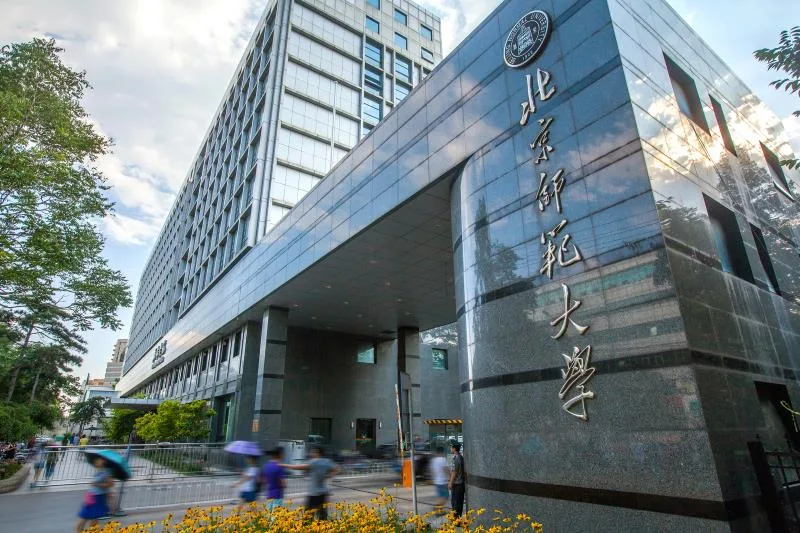
Government/University Scholarship
Beijing Normal University "Silk Road Muduo" Scholarship
Application status unknownNot verified
Beijing Normal University is a symbol of high-quality education in China, especially prominent in the field of Pedagogy. With the Beijing Normal University (BNU) "Silk Road Muduo" Scholarship, the university has created excellent conditions for excellent international students to have the opportunity to study and develop in the capital Beijing - a convergence of prestigious universities and rich culture.
TuitionAccommodationMedical insurance
- Scholarship type
- Government/University Scholarship
- Degree level
- Bachelor / Master / PhD
- Location
- Beijing · Beijing
- Application deadline
- Date to be confirmed
Overview
Beijing Normal University is a symbol of high-quality education in China
especially prominent in the field of Pedagogy. With the Beijing Normal University (BNU) Silk Road Muduo Scholarship
the university has created excellent conditions for excellent international students to have the opportunity to study and develop in the capital Beijing - a convergence of prestigious universities and rich culture.
Funding coverage
Funding tiers
Eligibility may differ by tier. Check the applicable degree and requirements.
Bachelor’s funding tier
- Eligible degree
- Bachelor’s
- Funding
- Undergraduate students
- Tier requirements
- Meets the visa, health and academic requirements for study in China
Master’s funding tier
- Eligible degree
- Master’s
- Funding
- Master’s students
- Tier requirements
- Meets the visa, health and academic requirements for study in China
Doctoral funding tier
- Eligible degree
- Doctoral
- Funding
- Doctoral students Scholarship funding content
- Tier requirements
- Meets the visa, health and academic requirements for study in China
Bachelor’s funding tier
- Eligible degree
- Bachelor’s
- Funding
- Undergraduates Full tuition waiver Free insurance Accommodation subsidy: RMB 700 per month Living allowance: RMB 2,500 per month
- Tier requirements
- Meets the visa, health and academic requirements for study in China
Master’s funding tier
- Eligible degree
- Master’s
- Funding
- Master’s students Full tuition waiver Free insurance Accommodation subsidy: RMB 700 per month Living allowance: RMB 3,000 per month
- Tier requirements
- Meets the visa, health and academic requirements for study in China
Doctoral funding tier
- Eligible degree
- Doctoral
- Funding
- Doctoral students Full tuition waiver Free insurance Accommodation allowance: CNY 1,000/month Living allowance: CNY 3,500/month Notes: Funding is limited to the normal duration of study; extensions are not funded. The scholarship is canceled if the student withdraws or suspends their studies. The scholarship cannot be reserved or applied for later. Application deadline and enrollment date
- Tier requirements
- Meets the visa, health and academic requirements for study in China
Bachelor’s funding tier
- Eligible degree
- Bachelor’s
- Funding
- Undergraduates Online application period: December 15–March 15 Deadline for admission without examination: March 1 Paper document deadline: March 31 Enrollment: September Master’s and … [source fragment]
- Tier requirements
- Meets the visa, health and academic requirements for study in China
Doctoral funding tier
- Eligible degree
- Doctoral
- Funding
- Doctoral students Online application: November 15–March 10 Paper materials deadline: March 30 Enrollment: September Tip: For smooth delivery, domestic applicants are advised to use EMS or SF Express; international applicants may use EMS, DHL, FedEx or UPS. Note: Scholarship deadlines may change annually; consult the latest admissions notice. Application requirements Basic Conditions Non-Chinese nationality, good health and friendly toward China. From a Belt and Road country. Good character and excellent academic results. No other government or institutional scholarship. Newly admitted international students planning to enroll in the same year. Age and Educational Qualification Requirements Undergraduates: excellent university entrance examination results or examination-exempt eligibility; no older than 40. Master’s applicants: excellent undergraduate results, solid academic foundation, research ability and innovation; no older than 50. Doctoral applicants: excellent master’s results, solid academic foundation and research ability; no older than 50. Language requirements
- Tier requirements
- Meets the visa, health and academic requirements for study in China
Bachelor’s funding tier
- Eligible degree
- Bachelor’s
- Funding
- Undergraduate students Chinese Culture applicants: HSK Level 4, score at least 180. Other programs: HSK Level 5, score at least 180. Meeting any one of the following permits exemption from the examination: | Test | Requirement | | --- | --- | | SAT | SAT I at least 1,300 and three SAT II subjects each at least 400 | | IB | At least three Higher Level subjects and total score at least 32 | | A-Level | At least three subjects graded C or higher | | ACT | Composite score at least 25 | | Other | Excellent high school results and excellent college/university entrance examination results |
- Tier requirements
- Meets the visa, health and academic requirements for study in China
Master’s funding tier
- Eligible degree
- Master’s
- Funding
- Master’s students International Chinese Language Education: HSK 6 ≥220 and HSKK Advanced ≥65 Literature majors: HSK 5 ≥210 Other majors: HSK 5 ≥195
- Tier requirements
- Meets the visa, health and academic requirements for study in China
Doctoral funding tier
- Eligible degree
- Doctoral
- Funding
- Doctoral students International Chinese Language Education: HSK Level 6 ≥ 240 and HSKK Advanced ≥ 65 Literature: HSK Level 5 ≥ 210 Other majors: HSK Level 5 ≥ 195 Additional Requirements Applicants under 18 at application must provide legal guardianship documents; the guardian must reside in China. Applicants who emigrated and acquired foreign nationality after birth, and whose one or both parents are Chinese citizens, must provide a valid foreign passport or nationality documentation held for at least four years and evidence of actual residence abroad for at least two of the preceding four years, with at least nine months’ residence per year. Naturalized foreign citizens originally from mainland China, Hong Kong, Macao or Taiwan must follow the above requirements. Application materials Scholarship application form: complete and print the form through BNU’s International Student Admissions System. Passport ID photograph Graduation certificate (expected graduation certification for current graduating students) Transcripts or high school transcripts Physical examination form Certificate of no criminal record Study plan or research plan Recommendation Letters:
- Tier requirements
- Meets the visa, health and academic requirements for study in China
Bachelor’s funding tier
- Eligible degree
- Bachelor’s
- Funding
- Undergraduates: 1 recommendation letter from a course teacher or principal Master’s / … [source fragment]
- Tier requirements
- Meets the visa, health and academic requirements for study in China
Doctoral funding tier
- Eligible degree
- Doctoral
- Funding
- Doctoral students: two recommendation letters from professors or associate professors Language proficiency certificate Other materials, if any: academic achievements, published papers and evidence of academic or extracurricular activities Application Procedure Complete the online scholarship application form. Log in to the application system, complete the information and upload relevant materials. Submit paper application materials to the university. Wait for the scholarship result. Annual Assessment Recipients undergo comprehensive assessment each May, including academic results and performance, to determine continued funding. Failure suspends eligibility for one year, with reassessment the following year. Two consecutive failures result in permanent cancellation of scholarship eligibility. Contact details International Student Admissions Office, Academic Affairs Department, Beijing Normal University, Area A, Main Building, 19 Xinjiekouwai Street, Haidian District, Beijing, China Postal code: 100875 Telephone: 0086-10-5880-2944 Email:
- Tier requirements
- Meets the visa, health and academic requirements for study in China
Bachelor’s funding tier
- Eligible degree
- Bachelor’s
- Funding
- Undergraduate: bk@bnu.edu.cn Master’s / … [source fragment]
- Tier requirements
- Meets the visa, health and academic requirements for study in China
Doctoral funding tier
- Eligible degree
- Doctoral
- Funding
- Doctoral: egp@bnu.edu.cn How to Apply for Beijing Normal University’s Silk Road Muduo Scholarship? For a smooth application for Beijing Normal University’s Silk Road Muduo Degree Student Scholarship, contact Riba for professional guidance to improve your chances of success. Contact Riba: Official website: Riba.vn Hotline: +84 888 666 350 / +84 888 666 152 For more scholarships, visit the studyinchina.net Scholarship Directory and explore further opportunities to study in China!
- Tier requirements
- Meets the visa, health and academic requirements for study in China
Requirements & documents
Application dates & process
Review Cycle: As specified in each host university’s admissions brochure
Universities & programs
Universities
About the university
Beijing Normal University (BNU), jointly built by the Ministry of Education and Beijing Municipality, is a national key university directly under the central government, with a primary focus on teacher education, educational science, and basic disciplines in liberal arts and sciences. It is a member of the national "985 Project," "211 Project," and "Double First-Class" A-level universities. During the Seventh and Eighth Five-Year Plan periods, it was one of the first ten key universities in China. BNU has been selected for the "National Teacher Training Program," "Everest Plan," "101 Plan," "Strengthening Basic Disciplines Plan," "2011 Plan," "111 Plan," "Talents Program," "Excellent Teacher Training Program," "Excellent Legal Talent Education and Training Program," the Beijing-Hong Kong University Alliance, the "Belt and Road" International Science Organization Alliance, and the China University Planetary Science Alliance. Its predecessor was the Normal School of the Imperial University of Peking, founded in 1902. In 1908, it was renamed the Capital Advanced Normal School and became an independent institution. In 1912, it was renamed Peking Higher Normal School, and in 1923, it became Beijing Normal University. In 1931 and 1952, Peking Women's Normal University and Fu Jen Catholic University were successively merged into BNU. In April 2019, the Ministry of Education officially approved the establishment of the Zhuhai Campus. As of March 2025, the university has two campuses in Beijing and Zhuhai, with 3 faculties, 29 schools, and 77 undergraduate programs. Its library holds over 5.84 million printed volumes and over 10.03 million e-books. It offers 36 first-level master's degree authorization points, 34 first-level doctoral degree authorization points, 6 professional doctoral degree authorization points, 25 professional master's degree authorization points, and 30 postdoctoral research stations. The university has 2,637 full-time faculty members, 16,543 full-time undergraduate students, 16,296 full-time graduate students, and 5,879 part-time graduate students. In the late 19th century, after the Qing government's defeat in the Sino-Japanese War of 1894-1895 and the signing of the humiliating Treaty of Shimonoseki, imperialist powers intensified their scramble for concessions in China, leading to a deepening national crisis. Concerned intellectuals, acutely aware of the urgent situation, sought to save the nation from extinction, and one of their measures was to establish new schools to cultivate talent. Historical evolution: In 1898, the Qing government formulated the "Imperial University of Peking Charter," stipulating that the university would offer general and specialized courses, and also set up a Normal School and a Translation Bureau. Subsequently, due to events such as the "Hundred Days' Reform," the Boxer Rebellion, and the invasion of Beijing by the Eight-Nation Alliance, the Imperial University of Peking suffered repeated setbacks and was even suspended. In 1901, the Qing government reestablished the Imperial University of Peking, first setting up an accelerated program divided into the "School of Official Training" and the "Normal School." The Normal School began enrolling students and opened on December 17, 1902, at the site of the Jing Shan East Horse Temple. In May 1908, the Advanced Normal School of the Imperial University of Peking was renamed the Capital Advanced Normal School, and its campus was moved to the Five-City School in Changdian. This marked the beginning of independent higher normal schools in China. In 1920, Peking Higher Normal School established the Graduate School of Education, admitting graduates of higher normal schools and specialized schools as well as outstanding third-year university students, pioneering the admission of graduate students through examinations in Chinese higher education.
Sources & verification
- Verification
- Not verified
- Verified on
- 2026-09-21
- Last updated
- 2026-09-24
- Source link
- studyinchina.net ↗
- Source notes
- Compiled from public StudyInChina information (source ID: 40c3730e-2f5e-470b-8aef-05b2c1a76768)
Confirm requirements, funding and deadlines in the admissions office’s current announcement.