
University Scholarship
Nankai University Scholarship
Application status unknownPartly verified
I. Scholarship Content and Standards: Undergraduate students: 10,000 RMB per person per year Master's and doctoral students: 15,000 RMB per person per year II. Open Majors: All majors are open. III. Applicant Eligibility: All students applying for self-funded study at Nankai University are eligible. IV. Application Period: March 1 to June 15 each year. V. Application Process/Method: 1. Applicants submit application materials to the Nankai University International Student Office before the deadline (June 15 each year, based on postmark date). 2. Applicant interview (subject to email notification). 3. Only applicants admitted through interview are eligible to apply for the scholarship. 4. The announcement time of the admission list and scholarship winners will be notified separately. 5. Nankai University will send the Admission Notice and the Visa Application Form for Foreign Students (JW202 form) and other documents in early July each year. VI. Required Application Materials:
Funding details pending.
- Scholarship type
- University Scholarship
- Degree level
- Bachelor / Master / PhD / Visiting Students
- Location
- Tianjin · Tianjin
- Application deadline
- Date to be confirmed
Overview
I. Scholarship Content and Standards:
Undergraduate students: 10
000 RMB per person per year
Master's and doctoral students: 15
II. Open Majors:
All majors are open.
Funding coverage
Funding tiers
Eligibility may differ by tier. Check the applicable degree and requirements.
Bachelor’s funding tier
- Eligible degree
- Bachelor’s
- Funding
- Undergraduates: RMB 10,000 per person per year Master’s, … [source fragment]
- Tier requirements
- All applicants for self-funded study at Nankai University are eligible [source wording contains a typographical error]. IV. Application dates: March 1–June 15 annually V. Application process/pathway: 1. Before the application deadline (June 15 each year, based on mailing date), submit to Nankai University’s International Student Office [source ends here]
Doctoral funding tier
- Eligible degree
- Doctoral
- Funding
- Doctoral students: RMB 15,000 per person per year II. Available Majors: No major restrictions III. Applicant Eligibility: All applicants for self-funded study at Nankai University are eligible [source wording contains a typographical error]. IV. Application dates: March 1–June 15 annually V. Application process/pathway: 1. Submit materials to Nankai University’s International Student Office before the deadline, June 15 each year, based on the mailing date. 2. Applicant interview, as notified by email [source ends with an unclosed parenthesis]
- Tier requirements
- All applicants for self-funded study at Nankai University are eligible [source wording contains a typographical error]. IV. Application dates: March 1–June 15 annually V. Application process/pathway: 1. Before the application deadline (June 15 each year, based on mailing date), submit to Nankai University’s International Student Office [source ends here]
Requirements & documents
Application dates & process
Review Cycle: Joint review by the China Scholarship Council and host university takes approximately 6–8 weeks
Universities & programs
Universities
About the university
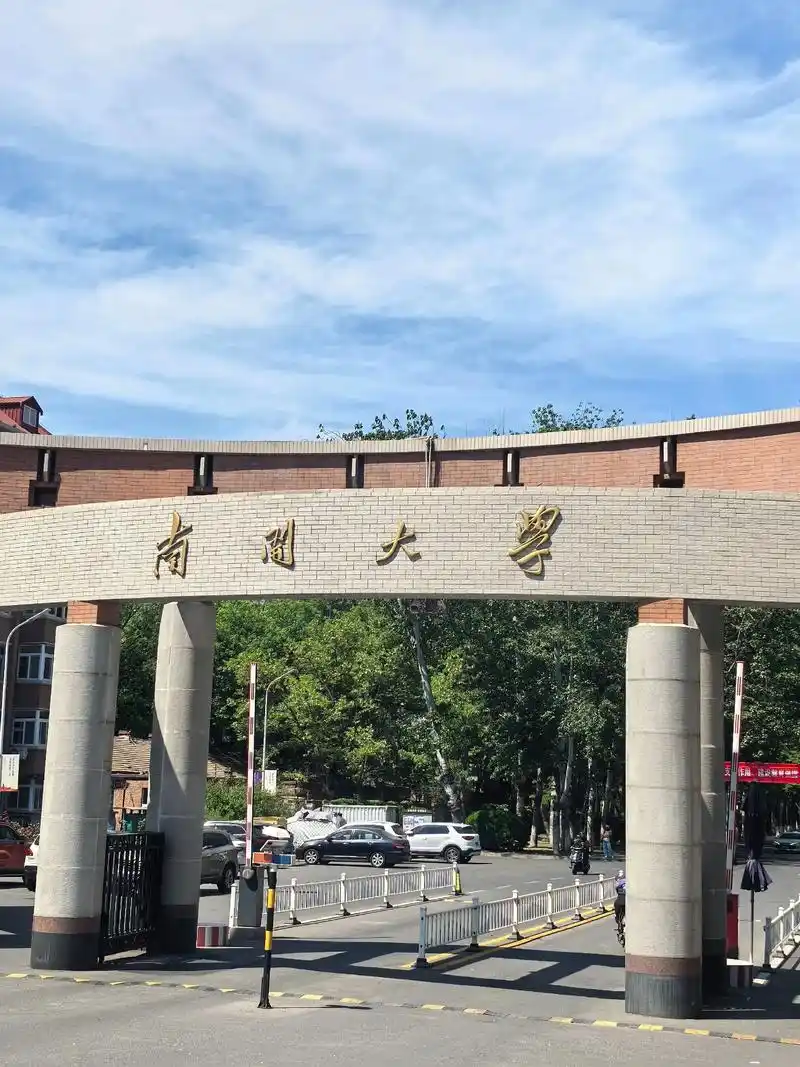
Nankai University, commonly referred to as Nankai, is located in Tianjin. It is a national key university directly under the Ministry of Education of the People's Republic of China and a central-administrated institution. It is a comprehensive research university that is part of the national "Double First-Class" Initiative, "Project 211," and "Project 985." It has been selected for the "Pilot Program for Training Top-Notch Students in Basic Sciences," the "Strengthening Basic Disciplines Program," the "Project 2011," the "Project 111," the Outstanding Legal Talent Education and Training Program, the National High-Level University Graduate Program for Public-Sponsored Students, the National Demonstration University for Deepening Innovation and Entrepreneurship Education Reform, the Chinese Government Scholarship Institution for International Students, and the Independent Degree Authorization Unit. It is a member of the International Forum of Public Universities. Nankai University was founded in 1919 by Yan Xiu and Zhang Boling, who adhered to the concept of saving the nation through education. In 1937, the campus was destroyed by the invading Japanese army, forcing the university to move south. The private Nankai University merged with Peking University and Tsinghua University in Changsha to form the National Changsha Provisional University; in 1938, it moved to Kunming, Yunnan, and was renamed the National Southwest Associated University. In 1946, it returned to Tianjin and was reestablished as a national university. After the founding of the People's Republic of China, through the adjustment of higher education institutions, it became a national key university with equal emphasis on arts and sciences. Since the reform and opening up, Tianjin College of Foreign Trade and the China Tourism Management Cadre College have successively merged into Nankai University. As of December 2024, the university has eight campuses: Balitai Campus, Jinnan Campus, TEDA Campus, and Zijinshan Road Campus, covering an area of 4,431,200 square meters, with a total building area of 2,021,700 square meters. It has 28 professional colleges, 84 undergraduate programs, 33 first-level doctoral degree authorization disciplines, 1 second-level doctoral program not covered by first-level disciplines, 7 professional doctoral degree authorization points, 6 first-level master's degree authorization disciplines, and 26 professional master's degree authorization points. There are 2,350 full-time teachers and 35,546 enrolled students, including 17,264 undergraduates, 12,155 master's students, and 6,127 doctoral students. The university originated in 1904 and was founded in 1919 by modern patriotic educators Yan Xiu and Zhang Boling, adhering to the concept of saving the nation through education. As early as 1916, Zhang Boling's younger brother, Zhang Pengchun, proposed the establishment of a university, which coincided with the ideas of Zhang Boling and Yan Xiu. He was thus appointed as the director of the preparatory office for Nankai University and drafted the "Nankai University Plan," earning him the title of "the planner of Nankai University" from Zhang Boling. On September 7 and 8, 1919, the private Nankai University held its entrance examination; on September 25, the private Nankai University held its opening ceremony, initially offering three departments: Arts, Sciences, and Commerce; on October 17, Nankai University was officially established. In the fall of 1920, Nankai University pioneered coeducation for male and female students. In 1921, it added a Mining Department (discontinued in 1926). In March 1922, the university leased over 400 mu of public land north and south of Balitai Village to build teaching buildings, male and female dormitories, and faculty residences. In June 1923, after the completion of Xiushan Hall, the first and second male dormitories, and nine buildings including female dormitories and faculty residences, a bronze statue of Xiushan was erected in commemoration. The Rockefeller Foundation donated $125,000 for construction and equipment, and industrialist Yuan Shuzhi donated 70,000 yuan to begin building the Science Hall—Siyuan Hall. In August, the private Nankai University officially moved to the new Balitai campus. In addition to the four departments of Arts, Sciences, Commerce, and Mining, a preparatory department was added, and the private Nankai University began to take shape. From 1927 to 1937, the private Nankai University saw significant development in various aspects. In 1927, it established the Social and Economic Research Committee (later renamed the Institute of Economics) and the Manchu-Mongolian Research Society (later renamed the Northeast Research Society). Lu Muzhai donated 100,000 yuan to begin construction of the "Muzhai Library." In 1928, graduate education began. The internationally renowned "Nankai Index" was released. This unofficial economic index long provided authoritative data for international academic research on the Chinese economy and served as an important reference for government decision-making, bringing international reputation to the Nankai Institute of Economics. In 1929, departments were reorganized into colleges, including the College of Arts, College of Sciences, College of Commerce, and a pre-medical program, with a total of 13 departments. In 1930, in accordance with the regulations of the National Government's Ministry of Education, the original departments of Arts, Sciences, and Commerce were converted into the College of Arts, College of Sciences, and College of Commerce. At the same time, the Department of Electrical Engineering was added to the College of Sciences, and in the following two years, the Department of Chemical Engineering and the Institute of Applied Chemistry were established. By the eve of the War of Resistance Against Japan, Nankai University had become a higher education institution with three colleges, 12 departments, and two research institutes, with 429 students and over 110 faculty and staff.
Sources & verification
- Verification
- Partly verified
- Verified on
- 2026-05-10
- Last updated
- 2026-09-24
- Source link
- www.campuschina.org ↗
- Source notes
- Official CampusChina guide (program code: 120061)
Confirm requirements, funding and deadlines in the admissions office’s current announcement.